
If your LinkedIn feed is anything like mine lately, you’ve probably noticed a massive divide forming. On one side, you have technology professionals swearing that Applicant Tracking Systems (ATS) are using AI to screen them out—filtering out candidates who, historically, would have been great fits. On the other side, you have countless recruiters and placement professionals swearing on their lives that absolutely no ATS on the market has the capability to screen out candidates using AI.
They claim it’s a myth. A ghost story engineers tell themselves to feel better about rejection.
This led me down a rabbit hole. If none of these systems exist, why are there lawsuits regarding them? If none of these exist, why do so many ATS companies list “AI Screening” as a headline feature on their sales pages?
Someone here isn’t telling the truth. Is it the people using the technology, or the people making it?
The Evidence
I decided to stop listening to the opinions and start reading the documentation. If you look at what the vendors themselves are saying, the “myth” becomes a feature list very quickly.
Bullhorn, a very popular ATS and CRM, stated in one of their blog posts:
The panelists highlighted several areas where AI is making an immediate impact:
- Screening and engagement: The fear that candidates don’t like automation is fading. Niad noted that in many cases, candidates report having better conversations with screening agents than with newly hired recruiters.
If there are no ATS systems that have AI screening, why do they purport to have it?
Then there is ADP. In a document published in December of 2024, they explicitly stated:
ADP’s Candidate Relevancy and Profile Relevance tools (for ease of reference both will jointly be referred to as “Candidate Relevancy” unless otherwise noted) use artificial intelligence and machine learning algorithms to conduct an initial review of an application
And let’s not forget HireVue. In a statement regarding explainability published in April of 2024, they state:
Our methods use AI to produce a single comprehensive assessment of each candidate, which organisations can then use to make better, more informed hiring decisions.
They even provided this helpful graph to show how their system organizes candidates:
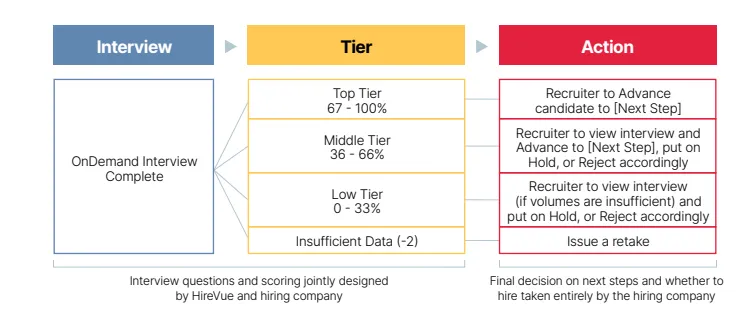
Still not convinced? SecondTalent provided a list of the Top 10 AI tools for Candidate Screening. If these tools don’t exist, someone should tell these companies they are selling vaporware:
- Harver
- SecondTalent
- X0PA AI
- ModernLoop
- Manatal
- HireEZ
- CVViZ
- Paradox
- Skeeled
- XOR
The Legal Reality
Beyond the marketing brochures, we have the legal system. Lawsuits don’t usually materialize out of thin air.
We have seen reports of HireVue’s AI discriminating against candidates based on facial attributes. We are currently watching Mobley v. Workday unfold, where age discrimination claims are being brought specifically due to the actions of the platform’s AI.
With all of this evidence—vendor documentation, feature lists, and active litigation—why are tech recruiters specifically continuing to claim that AI doesn’t exist in these systems? To state that AI isn’t screening candidates is completely out of touch with reality. At best, it’s naive optimism. At worst? It’s a flat-out lie that destroys credibility.
The Semantic Argument: “Ranking” vs. “Screening”
When I present this evidence, the goalposts usually move. The counter-argument shifts to: “Well, it scores and ranks candidates, but a human still has to click reject. It doesn’t screen out candidates.”
For this, I guess we have to go back to the dictionary. What does “screen out” mean again? According to Merriam-Webster:
screen out
1 : to remove (someone or something that is not suitable for a particular purpose) from a group that is being examined Example: screening out job applicants who have less than three years’ experience
Is “removing from a group that is being examined” not exactly what these tools are doing?
If an AI ranks 1,000 applicants and sorts them into “Top Tier” and “Bottom Tier,” and the recruiter only looks at the top 50, the other 950 have been screened out. Let’s act like professionals here. You can argue semantics all day, but scoring systems are a form of ranking desirable vs. undesirable. I challenge anyone to make a valid argument against that.
The next common argument I hear is: “Well, if this is so prevalent then list the companies that do this.”
(Spoiler: I did list several above).
But even when they are listed out, the argument circles back to how it’s either “not really AI” or “not really screening.” It is exhausting.
A Call for Transparency
At this point, I am fully convinced that there is no way this is just naivety. Recruiters that claim this either have genuinely poor ethics or are just in fear that AI is going to replace their own jobs.
I, for one, do not see anyone believing the statements that this stuff doesn’t exist anymore. The evidence is too loud. So here is a message to recruiters: Just admit that it exists.
If you use it, admit that and be transparent about how you use it. If you don’t use it, stop gaslighting us about the state of the industry. You’ll gain a lot more respect and trust from your leads that way.
But until then, I’m just going to keep adding on to my list of “professionals with unprofessional behavior” that I will not work with.